
From the Whetstone Mountains to Red Hawk: The Story of the J-6 Ranch
The cattle still graze. The Whetstones still stand. And the story of the ranch where a future president learned to ride fence is still being written.
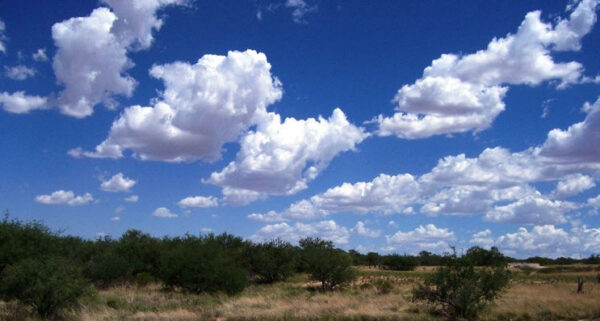 Big skies and open grassland at Red Hawk at J-6 Ranch.
Long before Red Hawk at J-6 Ranch became a place to build a home, this country belonged to cattlemen, mountain pastures and carefully bred herds. For one spring and summer in 1936, it also belonged to an eighteen-year-old from Massachusetts named John F. Kennedy.
The historic J-6, often written Jay Six, was a working cattle ranch about ten miles west of Benson. In 1953, Arizona Highways described its “40,000 rolling acres snuggled against and extending into the austere range of the Whetstone Mountains.”[1] That figure describes the full ranch operation of its day. Red Hawk occupies part of that historic country.
What makes the story unusual is that it never really ended. Cattle still graze across undeveloped Red Hawk land, and some homeowners can watch them just beyond their fences. Here, ranching history isn’t only something to remember. You can still see it.
Cattle country before the subdivisions
Southeastern Arizona’s nineteenth-century story is usually told through the silver of Tombstone and the copper of Bisbee. Cattle were just as enduring a force. Ranches fed the growing mining camps and tied the region’s economy to its grasslands, valleys and mountain ranges.
The work demanded resilience: uneven rainfall, scarce water, shifting forage and long distances between pastures. The Whetstone country offered something valuable in return, a combination of low-elevation range and cooler high-country grazing. That combination would become central to the Jay Six story.
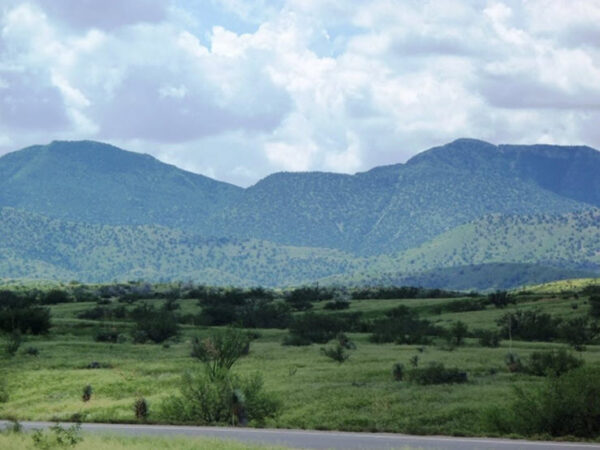 Summer green in the foothills: the kind of range that fed Jay Six cattle for decades.
Jack Speiden: an Easterner with a different idea
John G. F. “Jack” Speiden came west in 1932 seeking, as Arizona Highways put it, health, “elbow room and peace of mind.”[1] He was an unlikely cattleman. Yale-educated, he had served as a Marine in World War I, joined an expedition to Honduras and worked on Wall Street. In Arizona he immersed himself in animal husbandry and range management, then bought the property that became the Jay Six.[1]
Speiden didn’t simply want more cattle. He wanted better cattle on better land. The ranch’s stated purpose was “the improvement of the breed of registered Hereford cattle and the conservation of the range.”[1] He raised registered Herefords as breeding stock rather than show animals, with one herd bull to about thirty cows on a 700-acre pasture, and a small quarter-horse program on the side.[1]
His wife, Caroline, was a superb horsewoman who also raised Cairn terriers. Together they made the Jay Six both a working ranch and a lively home.[1]
A ranch built around the health of the range
The 1953 Arizona Highways account describes fourteen pastures, fenced and cross-fenced so that cattle could be rotated and several pastures rested each season while the new grass recovered. It describes seven deep wells, each near a supplementary feeding station, and a stream-fed orchard of peach, pear and apple trees.[1]
These details are more than picturesque. Rotating cattle and resting pastures were practical ways of protecting the grass that kept the ranch alive. The Jay Six was built on a principle that still holds across the West: the future of ranching depends on the future of the land. Water was always the heart of it. Today, Red Hawk is served by the Empirita Water Company, which draws on five wells under a 100-year Assured Water Supply.[5]
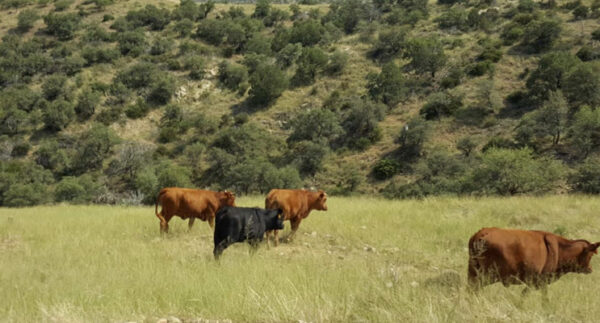
Cattle still graze on undeveloped Red Hawk land, just as they did on the Jay Six.
1936: Two young Kennedys come west
In April 1936, Joseph P. Kennedy Jr., then twenty, and his brother John, eighteen, arrived at the J-6. Jack had recently spent time in a Boston hospital, and their father wanted the boys outdoors, working hard in a dry, warm climate.[3] The arrangement came through Arthur Krock of The New York Times, who asked Speiden to take on two young men who, he said, needed “hardening up.” Speiden had never met their father.[2]
They didn’t come as guests. According to Speiden’s recollections, recorded by writer Bob Thomas, the brothers rounded up and branded cattle, doctored cows, treated cattle for screwworm and strung barbed-wire fence. They also made adobe bricks by treading the mud with their bare feet. By the time they left in September, Speiden remembered them as “leathertough and tanned.”[2]
Accounts differ on the details. Speiden said he “didn’t pay them a cent.”[2] Kennedy historian Michael O’Brien later described it as their first paying job, at a dollar a day, six days a week.[3] Estimates of their stay range from two months to the full spring and summer. What isn’t in doubt is that a future president spent 1936 doing real ranch work at the J-6.
The House That Jack Built
Among that summer’s projects was a one-room adobe office and den near the main ranch house, with a curved corner fireplace and window frames of mesquite. The crew mixed earth, water and straw, formed the bricks and raised the walls. Its original bear-grass roof leaked and drew rodents, so it was later replaced with shingles.[2]
The brothers left their mark in the most literal way. Their fingerprints were pressed into the drying adobe beside the fireplace, and both traced their initials into the foundation before it set. Those initials are now underground.[2] Speiden used the building as his office and den for roughly thirty years and called it “The House That Jack Built.” When Arizona Highways published Thomas’s account in 1999, it reported that the house still stood, looking much as it had when the Kennedys helped build it.[2]
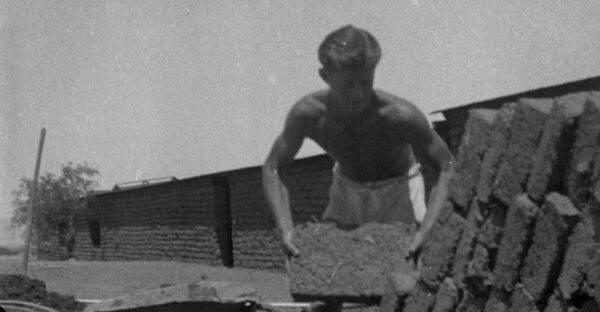
Eighteen-year-old Jack Kennedy stacking adobe bricks at the J-6 Ranch, 1936.
“From an old ranch hand”
In 1963, Speiden met President Kennedy at the Gridiron Club’s annual show in Washington and asked him to sign an old photograph: Jack at eighteen, perched on a J-6 corral fence. Kennedy wrote, “To Jack Speiden, from an old ranch hand.” When Speiden joked that the cowboy job would still be waiting after the presidency, Kennedy laughed and said he hoped he’d get paid next time.[2]
“To Jack Speiden, from an old ranch hand.”
— John F. Kennedy, 1963
The summer had stayed with him. Joe Jr. was killed in World War II when his bomber exploded over the English Channel. John returned to Arizona several times while recovering from his own war injuries.[2]
A ranch with a guest list
The Jay Six drew notable visitors over the years. Jack and Caroline Speiden welcomed author Thornton Wilder and Senator Barry Goldwater, among others.[4]
Its appeal, though, came from ordinary rhythms: horses to saddle, fences to ride, water to keep running and cattle to move. The Whetstone Mountains were never a stage set. They shaped the work and the life of the ranch.
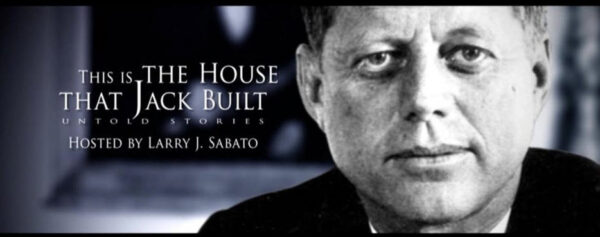
The J-6 story has been told on screen in “This Is the House That Jack Built,” hosted by Larry J. Sabato.
2002: Red Hawk begins a new chapter
Over the decades, portions of the historic ranch country passed into other hands. In 2002, the land that would become Red Hawk at J-6 Ranch was acquired from an intervening landowner, and the modern chapter began.
The new vision was residential rather than agricultural, but it kept what had always defined this place: room to breathe, long views, mountain air at about 4,500 feet and a direct connection to the open country of southeastern Arizona.
Today Red Hawk offers homesites of more than two acres near Benson, with underground water, power, internet and phone. Buyers can choose from 23 professionally designed home plans or a fully custom home, built by MC2 Homes with FrameUpNow engineered cold-formed steel framing.
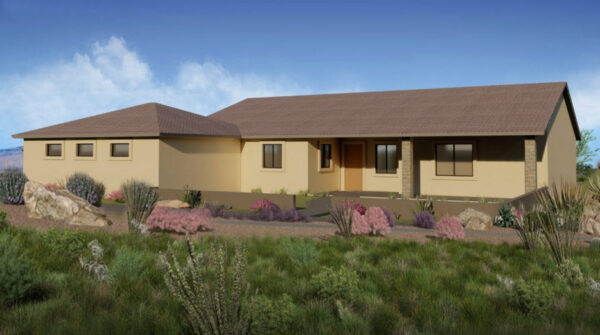
One of Red Hawk’s home designs (rendering). Homesites start at more than two acres.
The cattle are still here
Development hasn’t erased the ranch. Cattle continue to graze on undeveloped Red Hawk land, and for some residents the view beyond the fence still includes livestock moving across the grass beneath the Whetstones.
Plenty of communities borrow a ranch name without keeping any of the ranch. Red Hawk’s connection to the J-6 is tangible: the landscape is the same, the ranching is still next door and the history gives residents a sense of place that can’t be manufactured.
Ninety years on
Ninety years after two Kennedy brothers trod adobe mud at the J-6, this country is still telling its story. The ranch has changed hands and its land has found new uses, but the mountains remain, the grass still grows and the cattle still graze.
At Red Hawk at J-6 Ranch, history isn’t only something remembered. It’s something you can still see beyond the fence.
Explore homesites and home plans at Red Hawk at J-6 Ranch →
Sources
[1] Arizona Highways (October 1953), “Stay West, Young Man.” https://www.arizonahighways.com/archive/issues/chapter/Doc.347.Chapter.2
[2] Bob Thomas, “President Kennedy’s Cowboy Career,” Arizona Highways (August 1999). https://www.arizonahighways.com/archive/issues/chapter/Doc.951.Chapter.9
[3] “John F. Kennedy’s months as an Arizona ranch hand,” Arizona Daily Star (2011), citing historian Michael O’Brien; reproduced by Red Hawk at J-6 Ranch. https://redhawkj6.com/the-house-that-jack-built/
[4] Arizona Highways, “Taking the Off-Ramp” (Jay-Six Ranch retrospective). https://www.arizonahighways.com/archive/issues/chapter/Doc.1050.Chapter.4
[5] Red Hawk at J-6 Ranch, official website. https://redhawkj6.com/
The 2002 acquisition and continued grazing on Red Hawk land are from the owner’s own account.